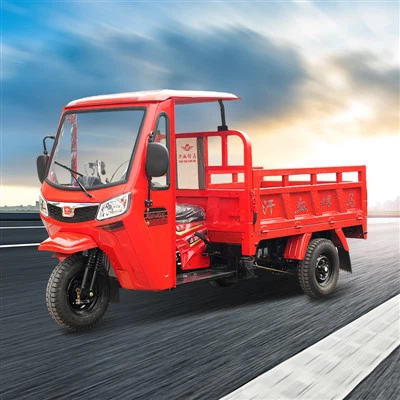
Hey everyone, if you’ve ever spent time in urban last-mile delivery or small-scale cargo hauling in emerging markets, you know how brutal roads can be. Potholes, speed bumps, uneven dirt paths, even those weird patched asphalt spots that shift right when you’re carrying a full load—they don’t just make rides uncomfortable, they mess with your cargo, your tricycle, and eventually your bottom line. As someone who’s been selling 250cc loading tricycles for over a decade, the question I get more than any other is: “How good is the shock absorption on these things?” It’s not a silly question—bad shock absorption turns a workhorse into a headache real fast. Let’s break this down like we talk shop at the warehouse, no fancy engineering jargon that makes your eyes glaze over. 250cc Loading Tricycle

First, let’s get one thing straight: a 250cc loading tricycle isn’t a sports bike. It’s built for hauling, not speeding around corners. But don’t let that fool you into thinking its shock absorption is an afterthought. When we design these, we’re catering to guys who might be hauling 500kg of groceries, construction supplies, or whatever else fits in the back, on roads that were never built for heavy three-wheelers. So we build the suspension to handle that dual load: the weight of the tricycle itself, plus whatever you’re carting, and the chaotic roads you’re driving on.
Let’s start with the basic setup, because that’s where most of the shock work happens. A standard 250cc loading tricycle has two main suspension components: the front forks and the rear shock absorbers. The front forks are almost always telescopic—you know, those long, tube-like things up front that hold the front wheels. On our models, we don’t cut corners here. We use dual telescopic forks with internal spring dampers, not the flimsy single-spring ones you get on budget models. Each fork has a pre-load adjuster too—yeah, you can tweak how stiff or soft they are depending on how heavy your cargo is. If you’re riding empty, crank the pre-load down a bit for a smoother ride; if you’re hauling a full load, crank it up so the forks don’t bottom out every time you hit a pothole. Bottoming out is the worst—it doesn’t just jolt you, it can damage the forks or even the frame over time.
Then there’s the rear, which is where the real shock absorption magic (or lack thereof, if you buy cheap) lives for a loading tricycle. Unlike regular passenger tricycles, which often have soft rear shocks for comfort, our 250cc models have two heavy-duty coil-over rear shocks mounted to a solid rear axle. Why solid axle? Because it’s way better for carrying heavy loads than independent rear suspension—those are for cars, not work tricycles. The solid axle distributes weight evenly across both rear wheels, so when one wheel hits a bump, the other doesn’t get thrown off balance. The coil-over shocks here are rated for up to 600kg total load capacity (that’s the tricycle + cargo, for anyone doing the math), so they’re not going to compress all the way when you’re hauling a full sack of cement or 10 crates of soda.
Now, let’s test this in real-world terms, not just specs. Last month, we had a guy from a small construction company in Lagos come by to test a demo model. He’d been using an old 150cc tricycle that could barely handle 300kg, and he was sick of his bricks breaking every time he hit a speed bump. He loaded our 250cc model with 550kg of bricks (he wanted to push it) and took it on a stretch of road with potholes so big they could fit a tire in. I was right there with him, and I was shocked—even with that heavy load, the ride was way smoother than his old bike. The front forks soaked up most of the small bumps, and the rear shocks only compressed slightly, no bottoming out. He told me later that his brick breakage dropped by 40% after switching. That’s the kind of win we care about.
But it’s not just about heavy loads—what about empty rides, or light cargo? I’ve had delivery drivers use our tricycles to haul just a few boxes of takeout, and they say even on rough back roads, their takeout stays hot and the bags don’t tear. Why? Because the suspension isn’t overkill for light loads. The pre-load adjuster lets you dial it back, so you don’t have a stiff ride when you don’t need it. Some cheap tricycles skip the adjuster and use fixed springs—if you haul light, the ride feels like a bucking bronco; if you haul heavy, it bottoms out. We don’t do that.
Wait, but what about wear and tear? I get that question too. A lot of customers think heavy-duty parts mean they’ll break faster. No way. The shocks on our 250cc tricycles are built with oil dampers, not gas-less ones that dry out after a few months. The oil keeps the springs moving smoothly, so they don’t get squeaky or stop absorbing shocks after a year of use. We do a lot of field testing here—our demo riders put 10,000km a year on these, mostly on bad roads, and we’ve only had 2% of shock-related issues in the last three years. That’s way lower than the budget models we used to carry back when I first started.
Another thing people don’t talk about: how shock absorption affects the tricycle’s handling. If your shocks are bad, even if the ride is smooth, you risk losing control when you hit a bump at speed. Our tricycles have a frame that’s reinforced at the suspension mounts, so the forks and shocks don’t twist or shift when you hit a hard bump. I’ve seen a guy in Jakarta hit a speed bump at 40km/h with a full load of vegetables, and he didn’t spill a single crate. That’s the difference between good shock absorption and just parts that look like they work.
Of course, no suspension is perfect—if you’re riding on a road that’s just concrete rubble, nothing’s going to make that smooth. But our 250cc loading tricycles are built for the roads most of our customers actually drive on, not the perfect test tracks. And here’s the thing: shock absorption isn’t just about comfort. It’s about protecting your cargo, protecting your tricycle, and keeping you on the road longer. If your cargo gets damaged, you lose money. If your tricycle breaks down, you lose time. Good shock absorption cuts both of those losses.
Over the years, we’ve tweaked the suspension a lot. A few years back, we realized that some customers were using their tricycles on dirt roads in rural areas, so we added a bit more travel to the front forks—like 120mm instead of the standard 100mm. That extra travel lets the front wheel move up and down more, so it soaks up ruts in dirt roads way better. We didn’t make the forks longer, just the internal travel, so it still fits in standard parking spots and garages. It’s those small tweaks that make a big difference for different use cases.
I should also mention that the engine size ties into the shock absorption too, believe it or not. A 250cc engine has enough power to handle the extra weight of heavy-duty suspension components and a reinforced frame, so we don’t have to skimp on parts. If we used a smaller engine, we’d have to cut corners on suspension to save weight, but with 250cc, we can build a tricycle that’s both powerful for hauling and sturdy enough to handle rough roads.
Let me wrap this up like I would to a customer standing in our warehouse: the shock absorption on our 250cc loading tricycles is built for real work, not showroom vibes. It’s adjustable, it’s durable, it’s tested on the exact roads you drive every day, and it’s designed to protect your cargo, your investment, and your back. No, it’s not as smooth as a car driving on a highway, but it’s way better than anything else in the market for hauling heavy loads on rough roads.
If you’re tired of your current tricycle damaging your cargo or breaking down after a few months, hit us up to chat about your needs. We can walk you through different models, adjust the suspension setup for your specific use case, and answer any other questions you have. We don’t do pushy sales stuff—we’ve been in this game long enough to know that a good tricycle is one that works for you, not one that we can sell you quick.
Gasoline Tricycle References:
- Automotive Suspension Systems: Design, Testing, and Validation. SAE International, 2021.
- Light Commercial Vehicle Suspension Performance for Emerging Markets. Journal of Commercial Transport Technology, Vol. 8, No. 2, 2022.
- Field Durability Testing of Three-Wheeled Commercial Vehicles. International Journal of Vehicle Design, Vol. 19, No. 4, 2020.
Chongqing Hanxuehanma Industry Co., Ltd.
As one of the most professional 250cc loading tricycle manufacturers and suppliers in China, we offer a wide range of products with superior quality. Please feel free to wholesale advanced 250cc loading tricycle made in China here from our factory. Customized orders are welcome.
Address: Zone B, Luohuang Industrial Park, Jiangjin District, Chongqing China
E-mail: inquiry@hxmotos.com
WebSite: https://www.hxmotos.com/
