If you’ve ever stared at your latest flagship phone, that bendable screen that fits so perfectly in your pocket, you’ve probably wondered – how long does it actually take to make a soft OLED screen? As someone who runs a small, tight-knit soft OLED screen supply team, I get this question all the time, usually from product designers or production managers who’re trying to nail down timelines for their own devices. The short answer isn’t just a number, though – it’s a messy, 4 to 6-week journey that involves more tiny, high-stakes steps than you’d ever guess, way beyond just slapping a few pixels together. Soft OLED Screen
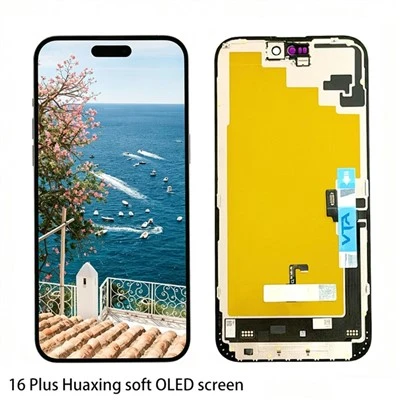
Let’s break this down real, no-fluff style. First, I need to make sure we’re on the same page: soft OLEDs aren’t the rigid glass OLEDs you’ve seen in old phones. These are built on ultra-thin flexible polymer substrates – think something as thin as a piece of notebook paper, but tough enough to bend 10,000 times without cracking. That difference is why their production timeline is so different from standard displays, and why the smallest misstep can delay the whole process.
Week 1 is all about pre-production prep, and this is where most people miss the critical fine-tuning. We don’t just grab a substrate and start printing. First, our engineering team spends 2 to 3 days on custom design checks, working directly with the client to tweak resolution, touch sensitivity, and bend radius (that’s how tight the screen can curve without breaking) to fit their device’s specs. Once that design is locked, the next big step is cleaning the flexible substrate. This isn’t just wiping it with a cloth – we use a super precise plasma cleaning process to blast every tiny dust particle (we’re talking 1 micron, or 1/100th the width of a human hair) off the polymer. Even one speck here can show up as a dead pixel, so we take 2 full days just getting that substrate 100% clean. Skip this step, and you’re looking at scrap later – we’ve learned that the hard way, so we don’t cut corners here.
Week 2 is the core of the OLED layer stack, and this is where the magic (and the time) happens. Soft OLEDs have multiple thin, functional layers that emit light, and each layer has to be deposited one at a time in a high-vacuum chamber – like a space-level clean environment, where even a stray air molecule can mess up the material. First, we deposit the backplane layer: this is the circuit that controls each individual pixel, made of thin-film transistors (TFTs). This takes 2 full days, because we use a process called photolithography to etch tiny circuit lines – lines that are just a few hundred nanometers wide. If the chamber temperature is off by even 1 degree, the etch is wrong, so our team monitors it around the clock. Next, we deposit the OLED emissive layers: red, green, and blue organic materials that emit light when electricity hits them. These are applied using thermal evaporation, where we heat small amounts of each material until they turn to vapor, then deposit them onto the substrate. This step takes another 2 days, because we have to apply each color in a precise pattern – no bleeding allowed, otherwise the colors look washed out. The final layer here is a thin encapsulation film, a ultra-barrier coating that keeps moisture and air out of the OLED layer, which would kill it instantly. That’s a 1-day step, but critical – we use a special flexible encapsulant, not glass, to keep the screen bendable. By the end of Week 2, we have a working, bendable OLED panel, but it’s still not a complete screen.
Week 3 is all about adding the touch and cover layers, and this is where the soft part really comes together. Most people think touch screens are just an add-on, but for soft OLEDs, the touch layer has to be flexible enough to bend with the OLED, so we don’t use standard glass touch sensors. We use a flexible touch sensor made of indium tin oxide (ITO) nano-wires, applied via a roll-to-roll printing process (that’s efficient, but still precise). This takes 2 days, because we have to align the touch sensor perfectly with the underlying OLED pixels – if it’s off by even 50 microns, touch response will be delayed or uneven. Next, we apply the flexible cover lens – this is the outer layer that you touch, made of ultra-thin polyimide (PI) plastic, not glass. We use a special optical clear adhesive (OCA) to bond the cover lens to the OLED and touch layer, and we have to do this in a way that traps zero air bubbles – even a tiny bubble here will show up as a distracting spot. That’s a 1-day step, and our team uses a vacuum lamination machine to make sure it’s flawless. By the end of Week 3, we have a bonded, flexible touch-OLED unit, but we still need to test every single unit before moving forward.
Weeks 4 and 5 are for rigorous testing and quality control, and this is where we spend most of our time to avoid sending out bad units. This isn’t just turning the screen on and checking for dead pixels – we run dozens of tests that are specific to soft OLEDs. First, visual inspection: we scan each unit under high magnification for dead pixels, color unevenness, or bubbles – that’s 1 full day, and we reject about 2% of units here, which is normal for our process. Next, functional testing: we run the screen at full brightness for 24 hours straight to check for burn-in (when static images leave a permanent mark) – that’s an overnight test, so it runs into Day 5. Then, and this is the big one for soft OLEDs, we run bend cycle testing: we bend the screen to its specified radius 10,000 times, then check for any cracks, delamination, or touch failure. That’s another full day, because we have to monitor each unit during bending. We also test touch response time (to make sure swipes and taps are fast enough), brightness uniformity, and color accuracy – all of which take another 2 days. By the end of Week 5, any unit that passes all tests is ready for packaging.
Week 6 is the final stretch, where we do custom packaging and preparation for shipping. We don’t just put the screen in a regular box – soft OLEDs are super fragile, especially before they’re integrated into a device. We use anti-static, shock-absorbent foam inserts to hold each screen individually, so they don’t get scratched or damaged during transit. We also add a protective film on the cover lens to keep it safe, and include a small test harness so our clients can quickly verify the screen works when they receive it. Packaging takes 2 days, then we do a final check of all shipping documents and coordinate with logistics – that wraps up the full timeline.
Wait, hold on – that’s the standard 6-week timeline, right? But there are variables that can shift things, for better or worse. If a client needs a custom specification (like a special bend radius, ultra-high resolution, or a specific size), that can add 1 to 2 weeks, because we have to re-calibrate our equipment. If we get a last-minute design change, that can delay things too, so we always tell clients to lock in specs at least a week before production starts. On the flip side, if we have a pre-built setup for a common size (like 6-inch or 6.7-inch screens, which are super popular for phones and wearables), we can sometimes cut the timeline down to 4 weeks, because we don’t have to do as much custom prep.
I should also be honest about why this process is so long – it’s all about precision. We’re working with layers that are thinner than a human hair, and if we skip even one small step, the screen will fail early. I’ve seen competitors cut corners here, using cheaper materials or shorter curing times, and their screens have a 30% higher failure rate after 1,000 bend cycles. That’s why we don’t do that – our clients rely on us for screens that hold up, so the extra time is worth it to get it right.
If you’re a product designer, OEM, or someone looking to work with soft OLED screens, this timeline is important to plan around. We always recommend reaching out at least 8 weeks before your planned production launch, just to build in a buffer for any last-minute tweaks or testing delays. For prototype orders, we can sometimes speed things up to 3 weeks, but that’s only if we have existing tooling and the design is locked – we charge a small rush fee for that, but it’s doable if you need something fast.

At the end of the day, making a soft OLED screen isn’t just a manufacturing step – it’s a combination of materials science, precision engineering, and strict quality checks, all stacked into a timeline that reflects how delicate and high-performance these displays are. If you’re ready to get a custom quote, test samples, or start a bulk order, feel free to reach out – we’re here to walk you through every step, no jargon, no hidden fees, just reliable soft OLED screens tailored to your needs.
Screen for Samsung References
- OLED Association. (2022). Manufacturing Processes for Flexible OLED Displays. Retrieved from industry technical publications
- Samsung Display. (2021). Technical Guide to Flexible Substrate and Encapsulation for OLEDs. Internal manufacturing technical reports
- International Society of Automation. (2020). Quality Control Standards for Thin-Film Electronic Displays. Global industry standards documentation
Shenzhen Longze Crossborder Ecommerce Development Co., Ltd.
Shenzhen Longze Crossborder Ecommerce Development Co., Ltd. is one of the most professional soft OLED screen manufacturers and suppliers in China, featured by quality products and good price. Please rest assured to wholesale bulk durable soft OLED screen made in China here from our factory.
Address: 302, Building B, Shengyang Technology Park, No. 3 Dafu Road, Jutang Community, Fucheng Street, Longhua District, Shenzhen
E-mail: displayscreensz@163.com
WebSite: https://www.lzphonedisplay.com/
