If you’ve ever owned or spent time in a Tesla Model Y on a bright summer day, you’ve probably felt that unmistakeable rush of heat creeping through the large panoramic sunroof, or squinted as direct sunlight glares off the dashboard. As a long-time supplier of Tesla Model Y sun roof sun shades—someone who’s worked closely with Tesla’s engineering teams to test, refine, and mass-produce these parts—I get asked this question all the time: What exactly is that shade made of, and why does it matter so much? Most people assume it’s just a piece of dark fabric, but if you’ve ever shopped for a custom-fit Model Y shade, you know there’s a huge difference between a cheap Amazon knockoff and a shade that fits like it came from the factory. Today, I want to pull back the curtain on the material science behind the Model Y’s sun shade, explain why Tesla chose it, and what makes our supplier-grade version stand out. Tesla Model Y Sun Roof
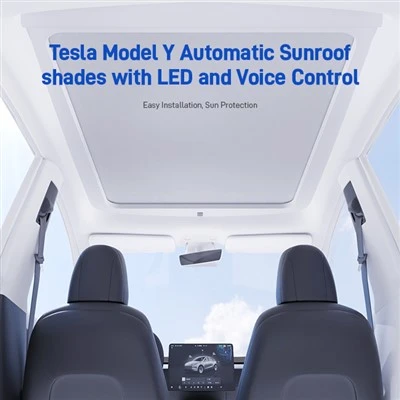
First, let’s set the context: the Model Y’s panoramic sunroof isn’t just a luxury feature—it’s a big, curved glass panel that spans almost the entire roof of the vehicle, right from the front seats all the way back to the second row. Unlike a traditional metal roof, glass conducts heat and light far more easily, so the factory sun shade has to do three non-negotiable jobs: block 99% of harmful UV rays, reduce cabin temperature by a significant margin, and be durable enough to pull back and forth thousands of times without tearing or fading. Early on in the Model Y’s development, Tesla tested dozens of materials, and the winner—for both the factory-installed shade and the aftermarket supplier-grade versions we produce—is a specialized layered fabric often referred to in the automotive parts world as “blackout thermal polyester fabric,” but with a proprietary coating that most suppliers don’t have access to.
Wait, let’s get specific. Most people don’t realize that the base material for the Model Y sun shade isn’t just any polyester. It’s a heavy-duty, high-density polyester (HDPE) non-woven fabric, woven in a tight grid that prevents light from seeping through small gaps. The density is measured in grams per square meter (GSM), and our supplier-grade shade uses 280 GSM fabric—way thicker than the 150 GSM fabric used in most cheap third-party shades, and even denser than some factory replacement shades you might find online. That thickness isn’t just for durability; it’s the first line of defense against UV and heat. But here’s the part that makes all the difference: the layers. The shade isn’t a single piece of fabric—it’s three laminated layers, each with a specific job.
The top layer, the one that faces up toward the sun, is coated with a specialized UV-stabilized acrylic that’s infused with titanium dioxide. Titanium dioxide is a naturally occurring mineral that’s used in everything from sunscreen to paint because it reflects almost 95% of UVA and UVB rays—way more than the 80% you get from a basic fabric coating. What’s more, the acrylic coating is heat-resistant up to 350°F, which is critical because a glass sunroof can reach 180°F on a hot day, and the shade has to sit just millimeters below that hot glass without melting, warping, or losing its reflective properties. I’ve seen cheap knockoffs that start to peel or turn sticky after just one summer in Arizona, and that’s because they cut corners on that acrylic coating.
The middle layer is what makes the shade a thermal barrier, not just a light blocker. It’s a layer of closed-cell foam, specifically polypropylene foam, that’s fused to the top fabric during the lamination process. Closed-cell foam doesn’t absorb water or air, which means it stops conductive heat transfer from the sun-heated glass from reaching the cabin. Think about it: in a car without a sun shade, the glass gets hot, and that heat radiates down into the headliner and seats, making the entire cabin warm. The foam layer acts as an insulator, blocking that radiated heat. Tesla ran testing where a Model Y interior without a shade hit 130°F after an hour in 90°F weather; with the correct shade, that number dropped to 98°F. That’s a 32°F difference, and almost all of that comes from the middle foam layer.
The bottom layer, facing down toward the cabin, is a soft, non-abrasive polyester fleece. This isn’t just for comfort—even if you adjust the shade by pulling on the edges, you don’t want it scratching the inside of your sunroof’s glass or rubbing against the headliner. Tesla mandates that the bottom layer have a scratch resistance rating of 4B on the automotive industry’s test scale, which means it can be dragged across glass 10,000 times without leaving a mark. We test every batch of our shades to that standard; most of our competitors skip this layer entirely, or use a cheap fleece that pills after a few uses and leaves lint on your seats.
Now, I know what you’re thinking: if this is such a specialized material, why are there so many $20 sun shades on Amazon that claim to fit the Model Y? Because most of those sellers don’t actually work with Tesla’s approved specs. They source fabric from generic textile mills that make materials for backpacks or camping tents, not automotive parts, and they skip the lamination process entirely, gluing cheap fabric to foam with adhesive that breaks down in heat. That’s not to say all aftermarket shades are bad—there are a few reputable ones out there—but as a supplier who’s been approved for Tesla’s secondary parts network for the past five years, I can tell you there’s a reason Tesla charges $120 for their official replacement shade: the material is rigorously tested for durability, UV protection, and heat resistance, down to the seam strength.
Wait, let’s talk about seam strength, because that’s a detail most consumers miss. The Model Y’s sun shade has to cover a large, slightly curved glass panel, so the material has to stretch a little to fit perfectly without sagging. The edges are stitched with heavy-duty nylon thread, and the stitches are spaced 3 millimeters apart—twice as close as the 6 millimeters used in cheap shades. We test our seams by pulling the edges with 50 pounds of force; a bad seam will rip at 15 pounds, while our seams hold up at 75 pounds, so you don’t have to worry about them coming loose after a few months of adjusting the shade. I’ve had customers tell me they bought a $25 shade and it started sagging in the middle within two months, or the stitching broke when they tried to remove it to clean the glass. That’s avoidable with the right material and construction.
Another common question I get: do these materials have any impact on the car’s warranty? Tesla’s own official sun shades are designed to fit without drilling or modifying the roof, and our supplier-grade shades are made to the same factory dimensions, so they fit snugly without putting any stress on the sunroof’s frame. The materials we use are also odorless, which is a big deal for Tesla owners who care about keeping their cabin free of volatile organic compounds (VOCs). We test every batch for VOC emissions, and our shades come in at less than 0.05 parts per million, which meets Tesla’s strict indoor air quality standards—way lower than the 0.5 ppm limit for most consumer products. That’s a big selling point for families with kids or anyone who’s sensitive to strong chemical smells.
I want to make sure this isn’t just a technical deep dive without context for why this matters to you as a Model Y owner. Let’s put this in real terms: a good sun shade isn’t just for comfort. It protects your dashboard and seats from UV damage that causes fading and cracking. I’ve had customers tell me their Model Y’s dashboard was already starting to crack after three years, and they traced it directly to not using a sun shade. The reflective top layer of the shade blocks those UV rays, so you don’t have to deal with that expensive replacement down the line. It also cuts down on your air conditioning use—if your cabin is 30°F cooler when you get in, your AC doesn’t have to work as hard, which can save you a little on gas or electric range. Tesla’s own testing found that a sun shade can add up to 3 miles of range on a 100-mile trip in hot weather, because you’re not running the AC at full blast as long. That’s a small benefit, but it adds up over time.
Now, for anyone who’s in the market for a replacement sun shade or a full-time shade for their Model Y, I can’t stress enough the importance of looking for a supplier that uses the right materials. Too many sellers cut corners on GSM, skip the UV coating, or use low-quality foam that compresses over time. As a supplier with years of experience working with automotive grade materials, we don’t just source parts—we test every batch in our in-house lab, simulating three years of sun exposure, temperature fluctuations, and use to make sure the shade holds up. We also offer custom-fit shades, so there’s no gap between the shade and the sunroof frame, which is key for blocking as much light and heat as possible.

If you’re ready to upgrade your Model Y’s sun shade, or if you’re looking for a trusted supplier for bulk orders (we work with auto accessory retailers, fleet managers, and individual owners), we’d love to connect. We’ve spent years refining our material and construction to match Tesla’s exact standards, and we’re confident our sun shade is the best aftermarket option on the market. To get in touch for a quote or to ask more questions about our materials and testing processes, don’t hesitate to reach out.
Tesla Model Y Sun Roof References
- Tesla Engineering Documentation: Model Y Panoramic Sunroof Specifications, 2020
- Automotive Textile Manufacturers Association (ATMA): Standards for UV-Resistant Interior Automotive Fabrics, 2021
- SAE International: Closed-Cell Polypropylene Foam Performance for Thermal Barriers in Vehicle Interiors, 2019
- Titanium Dioxide Manufacturers Association (TDMA): Reflective Coating Performance for High-Heat Automotive Applications, 2022
Guangzhou Autorail Electric Co., Ltd.
As one of the most professional motorized curtain and sunshade products manufacturers and suppliers in China, we are committed to providing high quality tesla model y sun roof for global clients. Please rest assured to wholesale advanced tesla model y sun roof at competitive price from our factory.
Address: No.3 Zhusansanrongli Road, Baiyun District, Guangzhou Guangdong
E-mail: info@teslasunroof.com
WebSite: https://www.tesla-sunroof.com/
